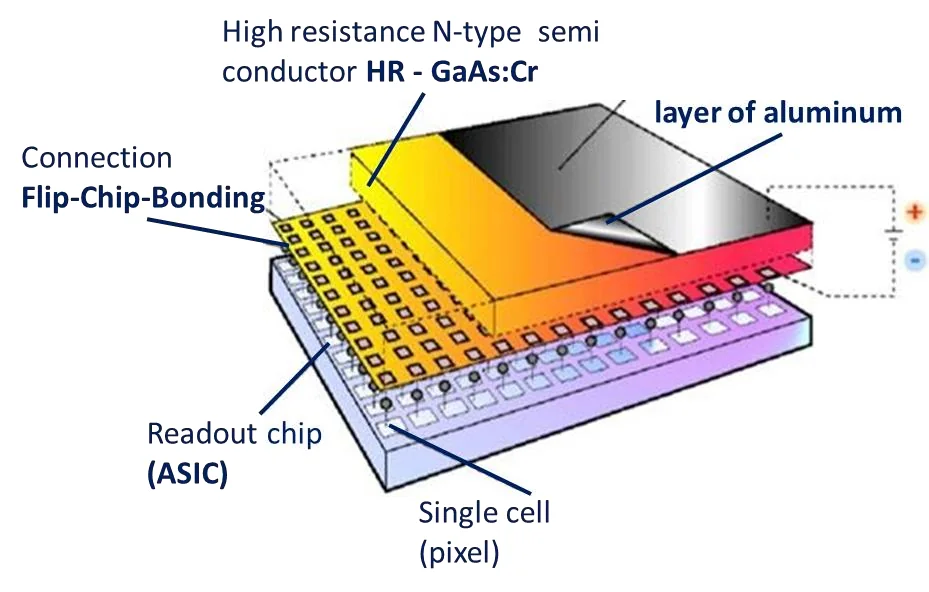
Zeelta X-ray sensors are monolithic pixelated HR-GaAs:Cr sensors. Each absorbed photon creates a charge proportional to its energy, which is collected by a single pixel and read out by an ASIC. The detector counts photons and sorts them by energy.
Key characteristics
Conversion
Direct, semiconductor
Detection mode
Photon counting with energy discrimination
Pixel pitch
From 35 µm
Density resolution
About 4,000 grey levels per energy channel
Interface
Metal contacts for flip-chip bonding to a photon-counting readout ASIC
Lifetime
Long service life thanks to high radiation resistance
Sensor structure: high-resistivity HR-GaAs:Cr layer with an aluminium contact, flip-chip bonded to a readout chip (ASIC). Each pixel is a single cell.
How it works
A bias voltage separates the charges created by an X-ray photon. Positive charges drift to a single electrode, so the coordinate of the event is defined unambiguously and the amount of charge gives the photon energy. Two close events are recorded separately.
Compared with scintillators
In a scintillator detector, light spreads over several photocells. That limits spatial resolution and makes it impossible to measure photon energy. Direct conversion removes that limit: detective quantum efficiency rises from about 35 to 40% to above 90%.
Advantages
Spectral (colour) imaging: element composition in addition to structure
High sensitivity, enabling lower X-ray dose for living specimens